
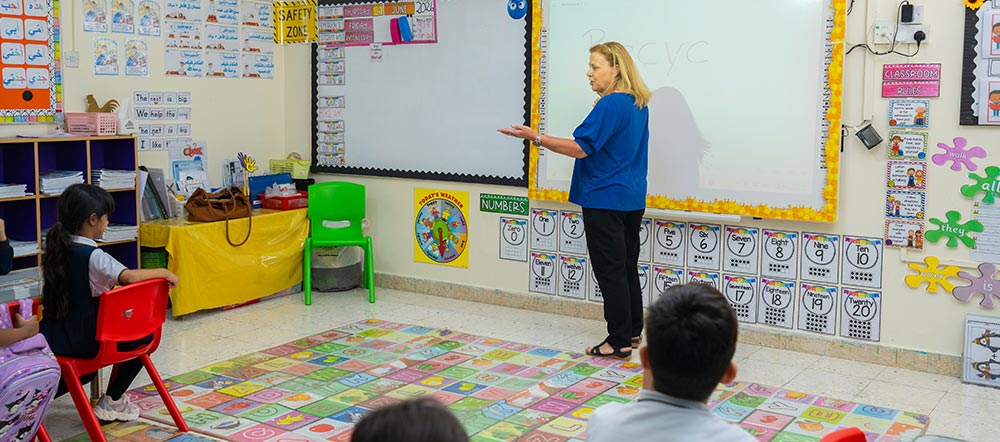

At FIA, student assessment takes various forms based on the subject, teacher, grade, and learners. Internal assessments are used both to support learning (assessment for learning) and to measure achievement (assessment of learning). Each type helps educators adapt instruction, evaluate teaching strategies, and ensure students receive the support they need.

Assessment for Learning (AfL) is a continuous, formative process that uses assessment to support and improve student learning rather than just measure it. Its main goal is to provide meaningful feedback that helps students understand their current progress, set learning goals, and know how to achieve them. AfL empowers teachers and students by identifying understanding, addressing misconceptions, and guiding instructional adjustments, creating an active and responsive learning environment.


At Future International Academy (FIA), external and international assessments play a key role in evaluating student learning against widely recognized standards. These assessments are conducted by accredited external bodies or international examination boards and include standardized tests, end-of-year exams, and global qualification programs.

Purpose: To assess prior knowledge, skills, and learning needs before instruction begins.
Examples: Pre-tests, diagnostic quizzes, and initial writing samples.
Purpose: to monitor learning and provide ongoing feedback for instructional refinement and student improvement.
Examples: Quizzes, class discussions, exit tickets, peer reviews, think-pair-share, thumbs up/down, questioning, observations, drafts, and learning journals
Purpose: To observe students during learning activities to gather evidence about their understanding, skills, and behaviours.
Examples: Observational checklists, anecdotal notes, group work observation, and monitoring student engagement, teachers’ notes.
Purpose: To communicate learning objectives and criteria for success to students so they understand what is expected and how they can achieve it.
Examples: Displaying learning goals, co-creating success criteria with students, and using exemplars to illustrate high-quality work.
Purpose: To help students reflect on their learning and take ownership of their progress.
Examples: Self-reflection journals, checklists, rubrics for self-evaluation, and self-scoring tools.
Purpose: To promote collaborative learning through constructive feedback among peers.
Examples: Peer reviews, group work evaluations, and peer feedback on assignments
Purpose: to identify students who may need additional support, specialized interventions, or further diagnostic evaluation.
Examples: language screeners, literacy screeners, numeracy screeners, behavioral assessments, cognitive or developmental screeners, and academic baseline assessments.
Purpose: To evaluate student learning at the end of an instructional period by comparing it against some standard or benchmark.
Examples: End of Term Exams, Mid-Term Exams, Quizzes, End-of-Unit Tests, and Final exams
Purpose: To assess students’ ability to apply skills and knowledge to real-world tasks.
Examples: Presentations, science experiments, projects, performances and portfolios.
Purpose: To collect a variety of student work overtime to show growth, reflect on learning, and demonstrate skills.
Examples: Collection of writing samples, art projects, multimedia presentations, and any student work that shows progress.
Purpose: To measure student performance against a set standard or specific learning objectives.
Examples: Collection of writing samples, art projects, multimedia presentations, and any student work that shows progress.
Purpose: measures what students know and inform what they are ready to learn next. It is administered twice a year (Fall and Spring Windows) as per the window shared from ADEK.
Target: Grades 3-9
Purpose: is a school level assessment designed for grade 10 students or students who are 15 years of age. Students are selected randomly and is taken every 3 years.
Target: Grades 10 or 11
Purpose: designed to assess proficiency in Arabic Reading, Grammar, Spelling, and Vocabulary through multiple choice questions in response to a variety of texts and situations. It is administered once every year.
Target: Grades 3 to 9
Purpose: To measure and improve Arabic language, Islamic Studies, National Identity, and Social Studies.
Target: Grades 3 to 9
Purpose: to measure trends in 4th and 8th-grade student achievement in mathematics and science, occurring every four years.
Target: Grades 4 and 8
Purpose: measure trends in reading and comprehension among fourth grade students globally to help policymakers and educators improve literacy.
Target: Grade 4
Purpose: To assess a high school student’s readiness for higher education, providing a common data point to compare applicants.
Target: Grades 11 and 12
Purpose: To assess the English language proficiency of non-native speakers, aiding in international work, study and migration to English-speaking countries.
Target: Grades 11 and 12
Purpose: to allow students to demonstrate readiness for university academics, potentially earn college credit, skip introductory courses and stand out in the college admissions process.
Target: Grade 12
In the journey of education, assessments play a pivotal role in shaping students’ understanding, guiding instructional strategies, and measuring progress. At Future International Academy, we believe in fostering a holistic approach to assessment that goes beyond traditional tests. Here is a summary of some of the best assessment practices implemented at our institution, designed to nurture individual growth, encourage critical thinking, and prepare students for success in a dynamic world.
Formative assessments are a key component of our teaching and assessment approach. They take place continuously throughout the learning process, offering immediate feedback to both students and teachers. Through quizzes, discussions, and interactive activities, these assessments help educators monitor understanding and adjust their teaching strategies, accordingly, supporting ongoing improvement.
Authentic assessments reflect real-world challenges and require students to apply their knowledge and skills in meaningful, practical ways. This may involve problem-solving, conducting research, or creating tangible outputs. By integrating authentic assessments, we aim to connect classroom learning with real-life expectations and better prepare students for the world beyond school.
Authentic assessments reflect real-world challenges and require students to apply their knowledge and skills in meaningful, practical ways. This may involve problem-solving, conducting research, or creating tangible outputs. By integrating authentic assessments, we aim to connect classroom learning with real-life expectations and better prepare students for the world beyond school.
Portfolios offer a comprehensive overview of a student’s academic journey. These carefully selected collections of work highlight progress, achievements, and areas for growth over time. They serve as a reflective tool for students while also providing parents and educators with a well-rounded perspective to monitor and support individual development.
Acknowledging the diverse needs of our students, we design assessments that are both inclusive and differentiated. Appropriate accommodations are provided to ensure all learners—regardless of their learning styles, abilities, or backgrounds—can effectively demonstrate their understanding. This approach reflects our commitment to equity and ensuring every student can succeed.
At Future International Academy, our assessment approach goes beyond traditional testing methods. By integrating a variety of assessment practices—including formative assessments for immediate feedback, performance-based and authentic evaluations, portfolios, and inclusive strategies—we create a comprehensive system that not only measures academic achievement but also nurtures a passion for learning, critical thinking, and personal growth. Through this approach, we equip our students with the skills and mindset needed to succeed in an increasingly complex world.
ADEK School Calendar - American - FIA (9203) - 2026-2027 - (Teaching Days: 182)
Essential guide to supporting your child at FIA.
Access, explore, and manage your child’s learning at FIA